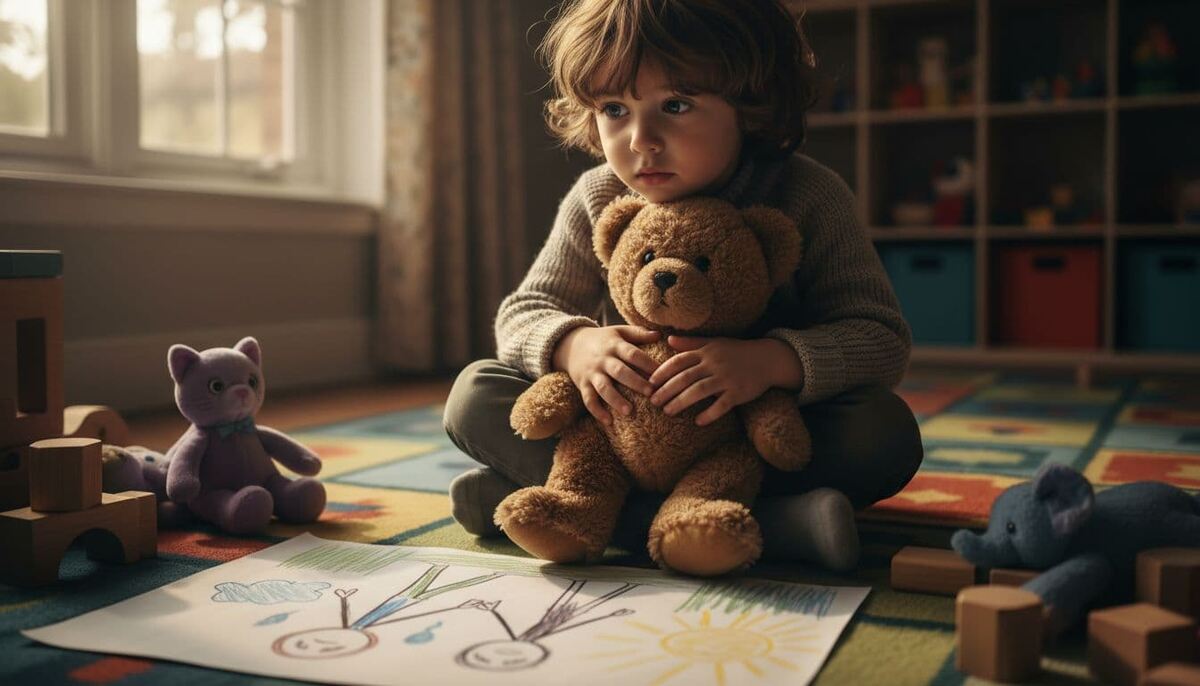
Grief is hard enough on adults. Then a 4-year-old looks up and asks, "When is Grandpa coming back?" and the room goes still.
If you're a parent, teacher, grandparent, or caregiver, you don't need a perfect speech. You need words a young child can hold. Grief lands differently with pre-K kids because they don't understand death, absence, and time the way older children do.
The good news is that simple, honest language works. And it works better than long explanations ever will.
What pre-K children understand about grief
Children ages 3 to 5 think in concrete ways. They understand what they can see, hear, and touch. Big ideas like forever, permanence, and "not coming back" are hard for them to grasp.
That means a child may understand that someone is gone, then ask for that person again an hour later. That's not denial. That's normal development.
Young children also don't grieve in a straight line. They may cry, then ask for a snack. They may seem fine at preschool, then melt down at bedtime. Adults sometimes read that as not caring, or "being over it." That's usually not what's happening.
A pre-K child can only carry so much at once. They dip in and out of grief because that's how their brains manage hard things.
Why simple, concrete language works best
At this age, words are taken literally. If you say someone "went to sleep," a child may start to fear sleep. If you say someone is "lost," they may think the person can be found.
Clear words feel safer because they match reality. Short sentences help too. They leave less room for confusion.
Say the true thing in the simplest way you can. "Grandpa died. His body stopped working. He can't come back." That may sound blunt to an adult, but to a young child, it is clear.
You can still be gentle. Your tone does a lot of the work.
How grief may show up in play, behavior, and questions
Some children talk about the loss right away. Others don't say much, but you see it in their play. A child may line up toy animals and say one died. They may play hospital, funerals, or goodbye scenes over and over.
That's not strange. It's one way children think.
You might also notice clinginess, tantrums, toileting accidents, baby talk, trouble sleeping, or more fear at separation. Some kids get angry. Some seem flat. Many ask the same question again and again.
Repetition can wear adults out, but it's often how young children check if the answer is still the same. They're building understanding in small pieces.
How to explain death in a gentle, honest way
When a death happens, start with one or two clear sentences. Sit at the child's level. Use a calm voice. Then stop and let the child react.
You don't need to fill every silence. A child may ask a question, walk off, then come back later and ask the same one. That's okay.
The same rule applies to serious illness and other big losses. Name what is happening in simple terms. "Mom is very sick, and the doctors are trying to help her." Or, "Your teacher won't be at school anymore because her father died."
You don't need a perfect script. You need clear words and a calm face.
Words that help, and words that can confuse
Helpful words are direct and plain. "Died" is clearer than "passed away." "Her body stopped working" is clearer than "we lost her." "He can't breathe, eat, talk, or come back" is easier for a young child to understand than a string of soft adult phrases.
Confusing words tend to sound kinder to adults than they feel to kids. "Went to sleep" can create bedtime fear. "Went away" can make a child wait at the window. "God took him" can leave a child angry or scared that God might take someone else.
If your family has spiritual beliefs, you can share them. Put the concrete truth first. For example: "Grandma died. Her body stopped working. We believe her spirit is with God." That order matters.
A child needs the physical fact before the abstract meaning.
Answering hard questions in short, truthful ways
Pre-K kids ask hard questions with no warning. "Where is she?" "Will you die?" "When is he coming back?" The best response is usually brief, honest, and calm.
If a child asks where the person is, you can say, "Her body is at the cemetery," or, "His body was cremated." If your family has a faith answer, add it simply. Then pause.
If they ask whether it will happen to them, don't promise things you can't promise. Instead say, "Most people live until they are very old. I plan to be here to take care of you for a long time." That gives comfort without making a false guarantee.
If they ask when the person is coming back, say, "He isn't coming back, and I know that hurts." Then stay with them. Often the answer a child needs most is your steady presence.
Helping pre-K kids feel safe while they grieve
After a loss, young children need more than words. They need the world to feel steady again.
That doesn't mean you have to act cheerful or hide your own sadness. It means showing them that feelings can be big and home can still feel safe.
Keep routines steady when you can
Routine is a kind of handrail for little kids. Breakfast at the usual time, the same bedtime song, the same teacher at drop-off, a familiar bath routine, all of that tells a child, "Life still has shape."
Small changes are fine. Life after loss is rarely neat. But too many changes at once can make grief feel bigger. If possible, keep meals, sleep, preschool, and playtime as predictable as you can for a while.
When a child is upset, simple reassurance helps more than long speeches. "You're safe." "I'm here." "Dad will pick you up after school." Use the same words often. Repetition builds security.
Use comfort objects, pictures, and familiar rituals
Some children need something to hold. A stuffed animal, blanket, favorite book, or family photo can become an anchor.
Photos also help make loss more real in a manageable way. A child can look, point, ask a question, then move on. Drawing pictures, lighting a candle with an adult, visiting a gravesite, or saying a simple goodbye ritual can help too.
Keep it low-pressure. Some kids want to talk. Some want to color quietly. Some want to play trucks right after looking at a photo. That's okay.
You aren't trying to force a feeling. You're making room for one.
When to get extra help and what support can look like
Most grief reactions in pre-K kids are painful but normal. Still, there are times when more help is a good idea.
Watch for signs that feel intense, long-lasting, or hard for the child to shake:
- major sleep problems that don't ease
- strong separation fear that disrupts daily life
- lasting aggression, shutdown, or big behavior changes
- repeated physical complaints with no clear cause
- talk about wanting to die, hurt themselves, or disappear
If you notice those signs, start with the child's pediatrician. A preschool counselor, child therapist, grief support group, or trusted faith leader may also help. If the child talks about self-harm or not wanting to live, get urgent mental health help right away.
Asking for help doesn't mean you've failed. It means you're paying attention.
What matters most
Pre-K kids don't need polished explanations. They need honest words, repeated reassurance, and adults who stay close when the feelings get messy.
If you're wondering whether you're saying it perfectly, that's usually the wrong question. The better one is this: am I being clear, calm, and present? For a grieving young child, that is what they will feel and remember.